On the night of August 13, the Rathdrum City Council sat down to vote on something that almost never comes up in a growing Idaho town: an emergency moratorium that would have stopped new building permits across the city. They didn't pass it. They didn't reject it either. They postponed it, citing water system pressure that city engineers say is already straining during peak summer demand.
If you're comparing Rathdrum to Hayden, Post Falls, or Coeur d'Alene right now, this is the story that doesn't show up on a portal listing page. It matters more than the median price, because it tells you something the median can't: whether the town's growth engine is running smoothly or running hot.
The Complaint That Came First
This didn't come out of nowhere. Back in October 2025, during the public hearing for the 436-lot Solara subdivision at Boekel and Meyer roads, a resident named Brighette Mastropaolo told the Planning and Zoning Commission that her home already lacked enough water pressure to shower at certain times of day. At that same hearing, the city's public works director, Chris Bain, said the system was pumping two million gallons under its maximum capacity and could support the new subdivision as proposed. The commission recommended approval anyway, and the council approved the plat that November.
Ten months later, the city's own consultants agreed there was a problem worth acting on. Council Member Laura Fuller cited a preliminary report from J-U-B Engineers describing summer demand pushing against supply limits, tank storage struggling during peak hours, and pump sequencing issues contributing to pressure fluctuations. She argued the situation met the legal bar for an emergency moratorium under Idaho Code section 67-6523, which allows a city to halt development if there's imminent peril to public health, safety, or welfare.
Other council members weren't convinced the legal threshold was met. Councilor Larry Sanders pushed back on calling isolated pressure dips an emergency:
"Continuous isn't three hours. Continuous isn't 25 minutes."
The North Idaho Building Contractors Association, through president Jessica Cargile, made a similar argument in writing, saying isolated pressure issues and general growth anxiety don't rise to the legal standard for a moratorium. Mayor John Hodgkins, for his part, acknowledged there's no fix in hand yet for the pressure problem, even as the council debated whether it counted as an emergency.
Nobody voted to stop building. Nobody voted to keep building either. The city simply ran out of certainty on which side of the legal line it was on, and pushed the decision down the road.
What Solara Tells You About the Pipeline
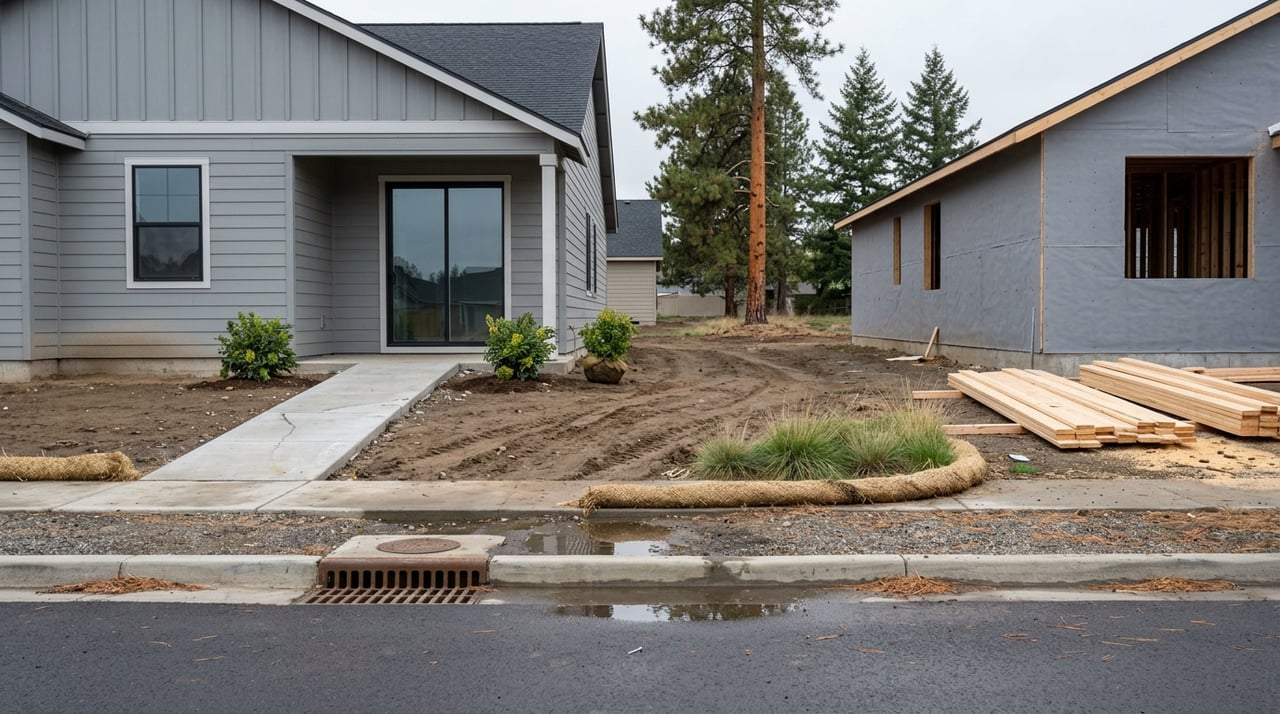
The reason this fight matters beyond city hall is scale. Solara alone brings 436 residential lots and 21 industrial lots to a city that, as of the most recent EPA-reported figures, serves roughly 8,100 to 10,300 people through its municipal water system depending on which federal dataset you check. The subdivision is being built in ten phases, with residential lots ranging from 6,500 to 12,920 square feet, the kind of production-home footprint that has made Rathdrum a common landing spot for buyers priced out of Hayden or Coeur d'Alene. Twenty-one of those Solara lots carry a workforce housing designation, with preference given to Lakeland School District teachers and staff, part of a deed-restriction partnership between developer Hayden Homes and the Panhandle Affordable Housing Alliance modeled on a similar project called Miracle on Britton.
That's a meaningful amount of future inventory sitting on a timeline that now includes an open question about water capacity. If you're watching a specific phase of Solara, or a lot in Grace Meadows or Brookshire, the pace at which future phases get permitted isn't just a construction detail. It's connected to whatever the city decides once its water master plan, first promised for completion by late spring 2026, actually lands with numbers the council can act on.
Two Rathdrums, One Median
Here's where the price data gets genuinely confusing if you only look at one source. Closed-sale figures put Rathdrum's median sale price at $530,000 in November 2025, up 17.8 percent year over year. A separate listing-based read puts the median list price at $674,000 in July 2026. Those numbers aren't contradicting each other by accident. They're measuring different things in a market where only 36 to 41 homes sell in a typical month. At that volume, a single subdivision's closing cohort, whether it's a run of Solara starter homes or a cluster of luxury sales, can swing the median by tens of thousands of dollars from one month to the next.
That volatility is a symptom of something structural. Rathdrum's inventory splits into two products that rarely compete for the same buyer. On one side sit production subdivisions like Solara, Grace Meadows, and Brookshire, built on standard city lots, tied to municipal water and sewer, and directly exposed to whatever the council decides about permitting pace. On the other side sit acreage estates like The Glades, a five-acre-parcel subdivision of custom mountain-modern homes, and gated communities like Lakeland Meadows near Twin Lakes, where four- and five-acre lots and price points well above a million dollars put buyers in a different conversation entirely.
| Production subdivisions | Acreage estates | |
|---|---|---|
| Example communities | Solara, Grace Meadows, Brookshire | The Glades, Lakeland Meadows |
| Typical lot size | 6,500 to 12,920 sq ft | 4.5 to 5+ acres |
| Exposure to city water debate | Direct, tied to municipal system capacity | Indirect, larger private lots and lower density |
| Buyer profile | First-time, move-up, workforce housing | Move-up, luxury, privacy-focused |
Averaging those two markets into a single median price tells you almost nothing about what either one actually costs. It's the real estate equivalent of averaging the temperature of a sauna and a walk-in freezer and reporting room temperature.
What This Means If You're Weighing Rathdrum Against the Neighbors
None of this means Rathdrum stops being a reasonable option next to Hayden or Coeur d'Alene. It means the reasons to choose it are shifting under the same headline of affordability. Rathdrum's fee structure has a history of moving in large steps rather than small ones. Back in 2017, the city raised water and sewer hookup fees by roughly 25 percent in a single adjustment after several years without a review, specifically because the fee schedule hadn't kept pace with the cost of the system. If the current water master plan results in a similar catch-up adjustment, that cost tends to land on new construction, which is exactly the segment of Rathdrum's market driving its reputation for value.
If you're comparing a new build in Rathdrum to a comparable listing in Hayden or Post Falls, the math you're actually running isn't just square footage per dollar. It's square footage per dollar, adjusted for the odds that permitting on later phases slows down, or that impact fees move again before your closing.
Questions Worth Asking Before You Write an Offer
- Which phase of the subdivision is this lot in, and has the builder said anything about a timeline for the remaining phases?
- Is this address on Rathdrum's municipal water system, or on a private well, and does that change how exposed it is to the current pressure debate?
- Has the seller or builder mentioned any recent change to water or sewer hookup fees for this development?
- How many homes actually sold in this immediate area in the last 60 to 90 days? A single closed sale can move a "market average" more than you'd expect here.
A Few Questions We Hear Often
Did the moratorium actually stop anyone from building? No. The council postponed the vote itself, so no citywide freeze took effect as of this writing. Existing permits and approved subdivisions like Solara continue moving forward under their existing agreements.
Is Rathdrum still cheaper than Coeur d'Alene or Hayden? Generally, yes, especially for production-subdivision new construction. But the gap is being measured against a market with low monthly sales volume, so any single-month comparison should be treated as a snapshot, not a trend line.
Should this change whether I look at Rathdrum at all? Not necessarily. It should change what you ask about a specific listing. A five-acre parcel in The Glades and a starter home in Solara's next phase are exposed to this story in very different ways.
Water pressure debates and phased subdivision approvals aren't the kind of thing most home searches start with, but they're exactly the kind of detail that separates a smooth closing from a frustrating one. If you're weighing Rathdrum against Hayden, Post Falls, or Coeur d'Alene and want someone who's tracking these fights in real time, not just the listing price, A-Team Real Estate would be glad to walk through what a specific address actually means for your timeline. Schedule a free consultation and let's look at the whole picture before you write an offer.